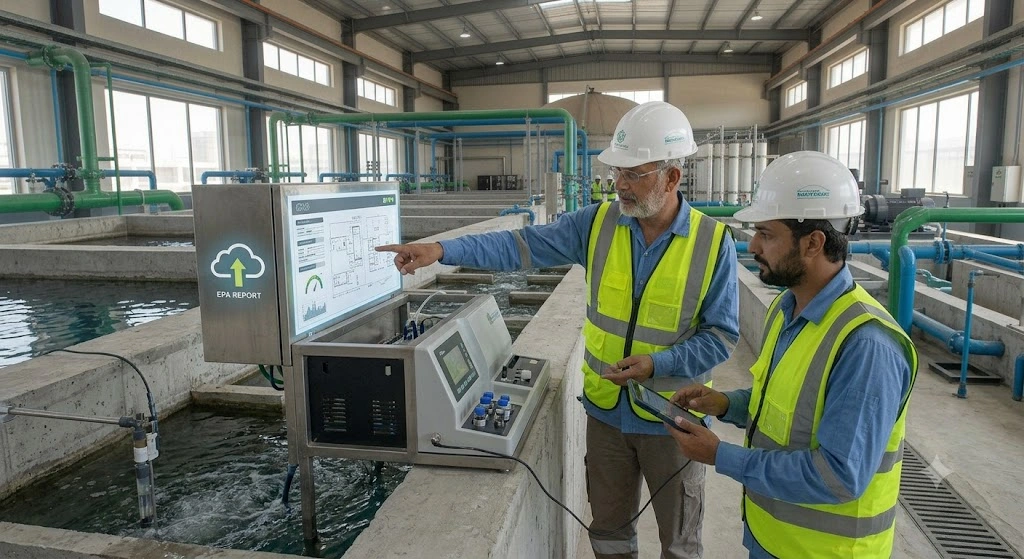
Most compliance failures do not occur because a treatment system is ineffective; they often result from documentation gaps that become apparent during an inspection when performance has not been monitored closely enough between manual testing dates. Real-time monitoring addresses this issue by providing continuous visibility into discharge parameters rather than relying on periodic snapshots, while also automating much of the record-keeping that provincial EPAs now expect from industrial facilities.
This article explains how real-time monitoring systems work, what EPA reporting automation Pakistan facilities are increasingly adopting looks like in practice, and how to determine whether implementing such a system is worthwhile for your specific compliance needs. If manual testing and paperwork have become an increasing burden for your compliance team, this guide provides a practical way to move forward.
Why Manual Compliance Documentation Falls Short
Traditional compliance monitoring relies on periodic manual sampling — grab samples tested at fixed intervals, logged by hand or in spreadsheets, and compiled into reports before EPA deadlines or inspections. This approach has real limitations:
- Gaps between test dates mean a parameter excursion can occur and self-correct without anyone knowing it happened, or worse, persist undetected until the next scheduled test.
- Manual data entry introduces errors, from transcription mistakes to inconsistent recording practices across shifts or personnel.
- Reactive reporting means compliance teams often compile documentation under time pressure right before a deadline, increasing the risk of gaps or inconsistencies.
- No early warning capability, since manual testing can’t alert operators to a developing problem before it becomes a documented violation.
For facilities in higher-scrutiny categories, or those with variable production processes, these gaps represent genuine compliance risk, not just an operational inconvenience.
How Real-Time Monitoring Actually Works
A real-time monitoring system uses in-line sensors and instrumentation to continuously measure key parameters — such as pH, flow, turbidity, conductivity, and in some configurations, specific chemical parameters — directly within the treatment process rather than through periodic manual sampling. This data feeds into a central system that:
- Logs continuous data streams rather than isolated point-in-time readings
- Flags deviations automatically when a parameter moves outside a defined acceptable range
- Generates timestamped records that create a defensible, continuous compliance history
- Supports automated reporting formats that can be structured to match EPA documentation requirements
The shift from periodic to continuous data is what makes real-time monitoring fundamentally different from traditional compliance testing — it changes monitoring from a reactive, point-in-time exercise into an ongoing operational practice. This shift is only possible with proper automation and controls integrated into the treatment system, since sensors alone don’t generate reports — the underlying control and data infrastructure is what ties readings together into a usable compliance record.
EPA Reporting Automation Pakistan Facilities Are Adopting
As provincial EPAs, particularly in Punjab and Sindh, place increasing emphasis on consistent self-monitoring and documentation, facilities are moving toward automating parts of the reporting process that were previously manual. Typical EPA reporting automation Pakistan implementations include:
- Automated data logging that eliminates manual transcription errors and creates a continuous, timestamped record
- Scheduled report generation, compiling monitoring data into formats aligned with EPA discharge monitoring report requirements
- Alert systems that notify plant operators immediately when a parameter approaches or exceeds compliance thresholds, allowing corrective action before a violation is recorded
- Historical trend analysis, making it easier to demonstrate consistent performance over time during an EPA review, rather than relying on isolated test results
This doesn’t eliminate the need for periodic lab testing of parameters that require laboratory analysis rather than in-line sensors, but it significantly strengthens the overall compliance documentation picture by filling the gaps between those tests.
What Real-Time Monitoring Can and Can’t Replace
It’s worth being clear about the limits of real-time monitoring, since not every parameter can be measured continuously with in-line instrumentation:
Parameter Type | Real-Time Monitoring Suitability |
pH, flow, temperature, conductivity | Well-suited to continuous in-line monitoring |
Turbidity, dissolved oxygen | Generally well-suited with appropriate sensors |
BOD | Not directly measurable in real time; typically still requires periodic lab testing |
Specific chemical constituents (heavy metals, certain organics) | Often requires periodic lab analysis, though some parameters have emerging real-time sensor options |
COD | Some real-time proxy methods exist, but periodic lab confirmation is generally still expected |
A well-designed compliance program combines real-time monitoring for parameters that support continuous measurement with a structured periodic lab testing schedule for those that don’t, supported by broader water quality monitoring practices — treating real-time systems as a complement to lab testing, not a full replacement.
Practical Benefits Beyond Compliance Documentation
While EPA reporting automation is the primary driver for many facilities adopting real-time monitoring, the operational benefits extend further:
- Early detection of treatment system issues, such as a developing membrane fouling problem or a biological treatment upset, often visible in monitoring trends before it becomes a compliance issue
- Energy and chemical dosing optimization, since continuous data allows more precise control than periodic manual adjustments based on outdated readings
- Reduced manual testing labor, freeing compliance staff to focus on analysis and corrective action rather than routine data collection
- Stronger position during EPA inspections, since a facility with continuous, well-documented monitoring data demonstrates proactive management rather than reactive compliance
Facilities that treat real-time monitoring purely as a compliance tool often underuse it — the same data that satisfies EPA reporting also supports better day-to-day plant operation.
Implementation Considerations
Before implementing real-time monitoring, a few practical factors are worth evaluating:
- Sensor selection and placement should match your specific critical parameters and process points, not a generic instrumentation package.
- Data integration and reporting format needs to align with your facility’s actual EPA reporting requirements, which can vary by province and industrial category.
- Calibration and maintenance schedules for sensors are essential, since inaccurate readings undermine the entire value of continuous monitoring — a poorly maintained sensor can create false confidence just as easily as it can catch a real problem.
- Staff training on interpreting alerts and trend data ensures the system’s early-warning value is actually used, rather than generating data nobody reviews until an EPA deadline approaches.
A Practical Example: Catching a Developing Problem Early
Consider a facility with continuous pH and conductivity monitoring on its treatment system output. A gradual upward drift in conductivity, invisible to a weekly manual test schedule, shows up clearly in continuous trend data days before it would approach a compliance threshold. This early visibility allows operators to investigate and correct the underlying cause — commonly a developing scaling issue or a shift in feed water characteristics — before it becomes a documented excursion, rather than discovering it only after the fact during scheduled testing.
FAQ
Q1. Does real-time monitoring completely replace manual water testing for EPA compliance?
No — it complements periodic lab testing rather than replacing it entirely, since some parameters like BOD and certain chemical constituents still require laboratory analysis. Real-time monitoring fills the gaps between manual tests, providing continuous visibility that periodic sampling alone can’t offer.
Q2. How does real-time monitoring support EPA reporting automation Pakistan facilities need?
It automates continuous data logging, generates timestamped records, and can compile monitoring data into report formats aligned with EPA requirements, significantly reducing manual data entry and the risk of documentation gaps or errors.
Q3. Is real-time monitoring only useful for large industrial facilities?
While large facilities with complex processes often see the clearest benefit, smaller facilities in higher-scrutiny categories or with variable production can also benefit significantly, particularly where manual testing has repeatedly missed developing compliance issues between test dates.
Q4. What parameters can’t be measured with real-time monitoring?
Parameters like BOD and certain specific chemical constituents generally still require periodic laboratory analysis, since reliable in-line sensors aren’t available for every regulated parameter. A complete compliance program combines real-time monitoring with structured periodic lab testing.
Conclusion
Real-time monitoring transforms EPA reporting from a periodic, manual scramble into a continuous, defensible compliance record — while also giving plant operators early warning of developing problems long before they become documented violations. As EPA reporting automation Pakistan facilities increasingly adopt becomes more common, the facilities benefiting most are those that use the data operationally, not just for compliance paperwork. WCSP has implemented real-time monitoring and compliance documentation systems for industrial clients across Pakistan since 2007, matching instrumentation to each facility’s specific regulatory and operational needs.
.