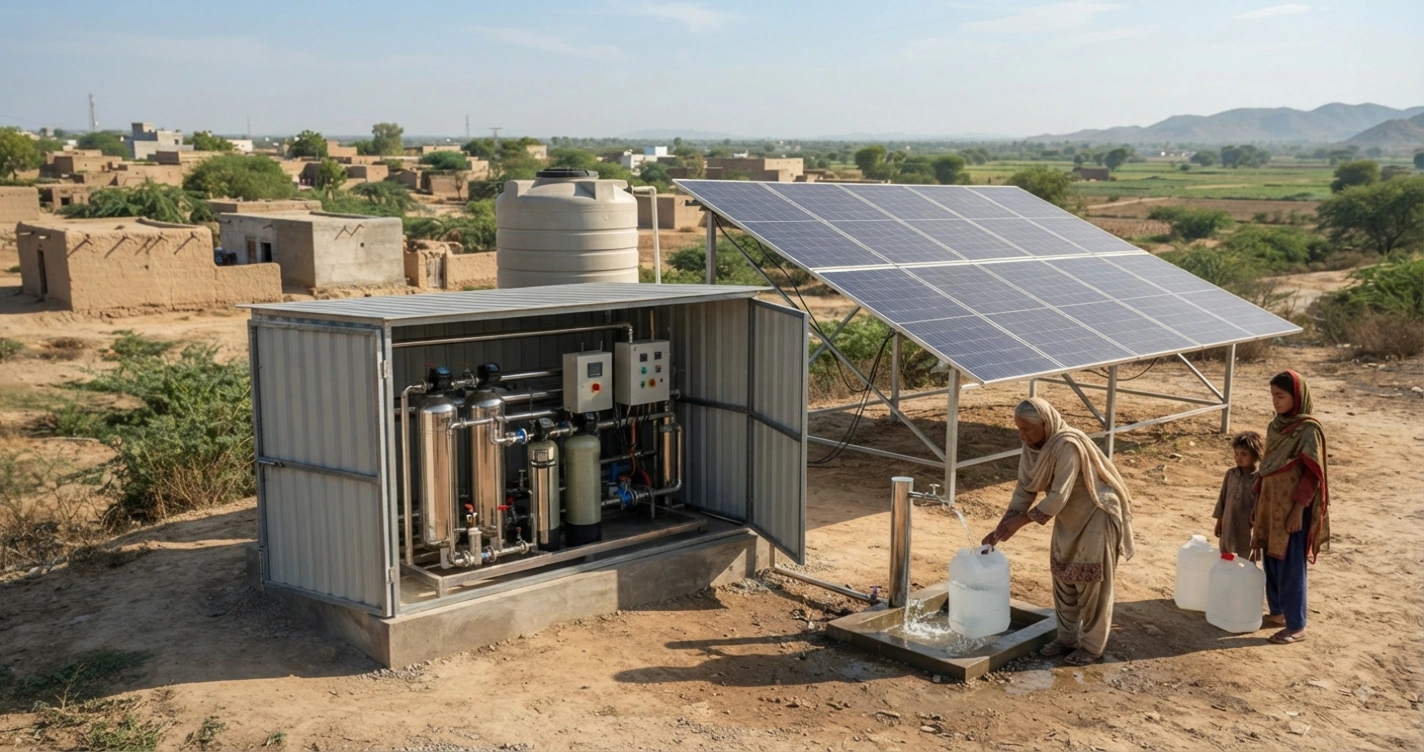
For many rural communities in Pakistan, access to clean drinking water is limited by more than just water quality—it is also affected by electricity availability. A village with brackish or contaminated groundwater may have access to RO treatment technology, but without a reliable power supply, operating a conventional RO plant is often impractical. This is where a Solar Ro Plant in Pakistan can bridge the gap, combining Reverse Osmosis technology with solar power to provide clean water without depending entirely on unreliable grid electricity.
This guide explains how solar-powered RO systems actually work, where they make the most sense across Pakistan’s rural and off-grid areas, what factors affect their design and cost, and what to consider before choosing this approach over a grid-connected alternative.
Why Grid Dependence Is a Real Barrier for Rural Water Treatment
Many of Pakistan’s rural and remote areas — parts of interior Sindh, Balochistan, and remote pockets of Punjab and Khyber Pakhtunkhwa — face a combination of two separate challenges: groundwater that’s often high in TDS, hardness, or in some regions documented contaminants, and inconsistent or entirely absent grid electricity access.
A conventional RO plant designed for grid power simply isn’t viable in these locations, regardless of how well-suited the treatment technology itself is to the water quality problem. This is precisely why an off-grid water treatment system, built around solar rather than grid power, matters as a distinct category of solution rather than just a variation on standard RO design — a pattern also seen in industrial contexts, where solar-powered ETPs are reducing wastewater treatment’s carbon footprint using similar underlying principles applied to effluent rather than drinking water.
How a Solar RO Plant Actually Works
A solar RO plant combines three core components working together:
- Solar photovoltaic (PV) array — generates the electricity needed to power the system, sized according to the plant’s energy demand and the site’s solar resource availability.
- Battery storage or direct-drive configuration — some systems store solar energy in batteries to allow operation during low-sunlight periods or at night, while simpler “solar direct-drive” systems operate only during daylight hours without battery storage, trading operating hours for lower system cost and complexity.
- The RO treatment system itself — pre-filtration, membranes, and pumps, generally similar to a conventional RO plant but often designed with lower energy-consumption components to better match the constraints of solar power generation.
The choice between battery-backed and direct-drive configurations is one of the most consequential design decisions for a solar RO plant, since it directly affects both system cost and how much treated water the plant can produce per day.
Battery-Backed vs Direct-Drive Solar RO: Key Trade-offs
Factor | Battery-Backed System | Direct-Drive System |
|---|---|---|
| Operating hours | Can operate outside daylight hours | Limited to daylight/sun-availability hours |
| Upfront cost | Higher — battery storage adds significant cost | Lower — no battery investment needed |
| Output consistency | More consistent, predictable daily output | Output varies with weather and season |
| Maintenance complexity | Higher — batteries need periodic replacement | Lower — fewer components to maintain |
| Best suited for | Communities needing consistent daily supply regardless of weather | Communities that can adapt usage patterns around daylight production |
For many rural community applications, a direct-drive system that fills a storage tank during daylight hours — allowing water to be drawn from storage throughout the day and evening — offers a practical middle ground without the added cost and maintenance burden of battery storage.
Where Solar RO Plants Genuinely Fit in Pakistan
Solar-powered RO isn’t the right solution for every situation — it makes the most sense in specific circumstances:
- Off-grid rural communities with no realistic timeline for grid electricity extension, where the alternative isn’t “solar vs grid RO” but “solar RO vs no treatment at all.”
- Areas with unreliable, intermittent grid power — even where grid connections exist, frequent outages can make a conventional plant unreliable, and solar (particularly with battery backup) provides consistency the grid alone can’t.
- Schools, health facilities, and community centers in remote areas, where consistent access to safe drinking water matters for daily operations, not just occasional use.
- Areas with strong solar resource availability — much of Pakistan, particularly Balochistan, southern Punjab, and interior Sindh, has strong year-round solar potential, which improves the practical viability and cost-effectiveness of solar-powered systems in these regions specifically. This complements broader efforts around water treatment options for remote rural homes, where power access is often the limiting factor for any treatment technology, not just RO.
What Affects the Cost and Design of a Solar RO System
Several factors shape both the design and cost of a solar RO plant beyond the core treatment capacity:
- Local solar resource — daily sunlight hours and seasonal variation affect how much PV capacity is needed to meet a given water output target.
- Source water quality — higher TDS or hardness requires more energy-intensive treatment, which in turn requires a larger solar array to power it.
- Battery storage decision — as outlined above, this is one of the biggest cost and complexity variables in the overall system design.
- Storage tank capacity — since production may be limited to daylight hours (particularly for direct-drive systems), adequate storage capacity is essential to meet demand throughout a full day and night.
- Site accessibility — remote installation sites can add to both equipment transportation cost and ongoing maintenance logistics.
Maintenance Considerations Specific to Solar RO Systems
Solar RO plants introduce some maintenance considerations beyond a standard grid-connected system:
- Solar panel cleaning — dust accumulation, particularly relevant in Pakistan’s drier regions, can meaningfully reduce panel efficiency if not addressed periodically.
- Battery health monitoring (for battery-backed systems) — battery capacity degrades over time and requires periodic assessment and eventual replacement.
- Remote monitoring capability — for installations in genuinely remote areas, the ability to monitor system performance remotely (where connectivity allows) reduces the need for frequent in-person site visits to catch problems early.
- Local technical training — because remote sites may not have quick access to specialized technicians, training local operators on basic system maintenance and troubleshooting significantly improves long-term system reliability.
Conclusion
A solar RO plant in Pakistan offers a genuinely practical path to clean drinking water for communities where grid electricity is unreliable or unavailable entirely — turning “no power means no treatment” into a solvable problem rather than a permanent barrier. The right configuration (battery-backed versus direct-drive) depends on the specific community’s demand pattern and budget, but either approach represents a meaningful improvement over no treatment access at all, complementing broader efforts around integrated wastewater treatment for rural areas that many of these same communities also need. Water Care Services Pakistan (WCSP) has supported water treatment system design across Pakistan since 2007, including off-grid and rural deployment scenarios, and can help assess whether a solar-powered approach fits a specific community’s needs and local solar resource availability.
FAQ
Q1: How much water can a solar RO plant produce per day?
This depends heavily on the system’s capacity, local solar resource, and whether it includes battery storage. Direct-drive systems are typically limited by daylight hours, while battery-backed systems can maintain more consistent daily output regardless of the time of day treatment actually occurs.
Q2: Is a solar RO plant more expensive than a grid-connected RO plant?
Upfront cost is generally higher due to the solar PV array and, if included, battery storage — but for genuinely off-grid locations, this comparison isn’t really solar versus grid RO, since grid connection often isn’t a realistic option at all. In that context, the relevant comparison is solar RO versus no reliable treatment access.
Q3: Do solar RO plants work during cloudy or rainy weather?
Direct-drive systems without battery storage will see reduced output during low-sunlight conditions, while battery-backed systems can draw on stored energy to maintain more consistent operation. Adequate water storage tank capacity also helps bridge gaps in production during periods of lower solar generation.
Q4: How long do solar panels and batteries last in a solar RO system?
Solar panels typically have long operational lifespans with proper maintenance, while batteries generally have a shorter service life and require periodic replacement as capacity degrades over time. Regular maintenance and monitoring help maximize the lifespan of both components.
Q5: Can an existing conventional RO plant be converted to solar power?
In some cases, yes, though this depends on the existing system’s energy requirements and whether the pumps and controls are compatible with solar-generated power, potentially requiring some component modification. A proper technical assessment of the existing system is needed before committing to a solar conversion.