If your textile plant in Faisalabad, Lahore, or Karachi is still running an activated sludge system from two decades ago, there is a strong chance your effluent discharge is already out of NEQS compliance. Pakistan’s textile sector accounts for roughly 60% of the country’s total export earnings, according to the Pakistan Bureau of Statistics, yet it also produces an estimated 900 million litres of wastewater every day, according to the Pakistan Council of Research in Water Resources. That volume, combined with the chemical complexity of reactive dyes and finishing chemicals, makes textile wastewater treatment one of the most demanding challenges facing plant managers today.
This article explains exactly why conventional treatment systems are no longer enough, how Moving Bed Biofilm Reactor technology works for textile effluent specifically, what NEQS requires of your discharge, and how Water Care Services Pakistan has been helping mills across Punjab and Sindh build treatment systems that hold up under real operating conditions.
Why Is Textile Wastewater So Difficult to Treat in Pakistan?
Textile wastewater is exceptionally hard to treat because it combines high chemical oxygen demand from sizing agents, persistent synthetic dyes that resist biological breakdown, suspended solids from fibre processing, and pH swings across a single production shift. No single technology resolves all of these at once, which is why most mills need a multi-stage process.
Walk through a typical Faisalabad composite textile mill and the effluent picture is complex. Desizing and scouring stages contribute high BOD loads. Dyeing baths, particularly those using reactive and vat dyes, release chromophoric compounds that biological systems struggle to break down. Finishing stages add surfactants and formaldehyde-based resins. The result is an effluent with COD values routinely exceeding 1,500 mg/L and colour levels that make the receiving nullah visibly contaminated.
The Pakistan Environmental Protection Agency measured textile effluent in Faisalabad’s industrial zones and found average COD levels of 1,800 mg/L, nearly nine times the NEQS discharge limit of 200 mg/L. Biological treatment alone cannot bridge that gap without advanced pre-treatment or a hybrid technology stack. This is the core reason why MBBR for textile effluent has become the preferred upgrade path for mills that have outgrown their old ASP systems.
What Are the NEQS Standards Your Textile Plant Must Meet?
Pakistan’s National Environmental Quality Standards for industrial liquid effluent set mandatory discharge limits that every textile mill must comply with. Key parameters include COD at 200 mg/L, BOD at 80 mg/L, total suspended solids at 150 mg/L, pH between 6 and 10, and temperature below 40 degrees Celsius. Colour has no explicit numeric NEQS limit but is assessed on visual inspection and can trigger EPA notices.
Key NEQS Parameters for Textile Effluent
Provincial EPAs in Punjab, Sindh, and KP enforce these standards through periodic inspections and, increasingly, real-time monitoring requirements under the National Environmental Information System. Fines for non-compliance begin at Rs 100,000 per day under PEPA 1997 and its provincial amendments, escalating to plant closure notices for repeat violations.
Beyond the core parameters, mills exporting to European markets face additional requirements under the ZDHC (Zero Discharge of Hazardous Chemicals) framework, which restricts specific dye classes and finishing chemicals. WCSP’s water quality monitoring service (link: /water-quality-monitoring/) helps mills map their current effluent profile against both NEQS and ZDHC requirements before any treatment system upgrade begins.
The critical point for plant managers is this: NEQS was last updated in 2001. Regulators in Punjab have been pushing for stricter colour and heavy metal limits for textile discharge, and several Lahore EPZ units have already received advance notices about upcoming regulatory tightening. Building a treatment system to current NEQS minimums may not be sufficient for a five-year horizon.
How Does MBBR Technology Work for Textile Effluent Treatment?
MBBR, or Moving Bed Biofilm Reactor, treats wastewater by keeping plastic biofilm carriers continuously moving through an aerated tank. Microorganisms colonise the surface of these carriers and digest organic contaminants as the effluent flows past. Because the biomass is attached to the carriers rather than suspended freely, MBBR handles load fluctuations better than conventional activated sludge without requiring the same reactor volume.
The carriers, typically high-density polyethylene rings or cylinders with a protected inner surface area, are kept in motion by aeration in aerobic stages and by mechanical mixing in anoxic stages. The effective surface area of modern carriers reaches 500 to 900 square metres per cubic metre of carrier, giving MBBR systems a biological treatment capacity that activated sludge systems cannot match at equivalent tank sizes.
Why MBBR Suits the Variable Load Profile of Textile Mills
Textile mills do not produce uniform effluent. A reactive dyeing batch generates a very different effluent load than a washing stage. MBBR handles this variability well because the biofilm on the carriers acts as a buffer. When organic load drops, the biofilm retains its microbial community rather than dying off the way suspended activated sludge does during lean periods. When load spikes, the system responds without the settling instability that causes conventional ASP to fail spectacularly during production surges.
For the particularly challenging task of dye removal wastewater treatment, MBBR is most effective when combined with upstream electrocoagulation or a coagulation-flocculation stage. Reactive dyes are water-soluble and largely non-biodegradable. Electrocoagulation destabilises and precipitates these dye molecules before the biological stage, enabling the MBBR to focus on the biodegradable fraction. WCSP’s electrocoagulation service (link: /electrocoagulation/) is routinely integrated with MBBR installations at textile sites in Gujranwala and Sialkot.
Comparing Treatment Technologies for Textile Wastewater Treatment in Pakistan
Choosing between conventional activated sludge, MBBR, and MBR depends on your site constraints, budget, existing infrastructure, and compliance target. MBBR offers the best balance of treatment performance, retrofit simplicity, and capital cost for most Pakistani textile mills operating medium-to-large scale production.
| Parameter | Conventional ASP | MBBR | MBR |
| Footprint | Large | 30-40% smaller | Smallest |
| BOD Removal | 70-80% | 90-95% | 95-99% |
| Colour/Dye Removal | Low | Moderate (with EC) | High (with EC/ozone) |
| COD Handling | Limited | High load capable | Very high |
| NEQS Compliance | Often fails | Achievable | Fully achievable |
| Sludge Output | High | Medium | Low |
| Capital Cost | Low | Medium | High |
| Retrofit Ease | N/A | Easy | Moderate |
The table above reflects typical performance ranges based on WCSP’s project data and published industry benchmarks from the International Water Association. Your specific effluent composition will affect actual outcomes, which is why WCSP always recommends a pilot-scale jar test and treatability study before committing to a full system design.
| Expert Insight from WCSP’s Engineering Team
After 17 years of designing treatment systems across Pakistan’s textile belt, the single most common mistake we see is mills sizing their MBBR purely on average COD load. Textile mills have peak load events, typically at shift changes or dye-batch transitions, that are 3 to 4 times the daily average. Size your aeration and carrier volume for peak load, not average load, or your system will underperform on the days the EPA inspector visits. Always request a 72-hour effluent composite sample before finalising design parameters. |
What Does a Textile Wastewater Treatment System Using MBBR Actually Look Like?
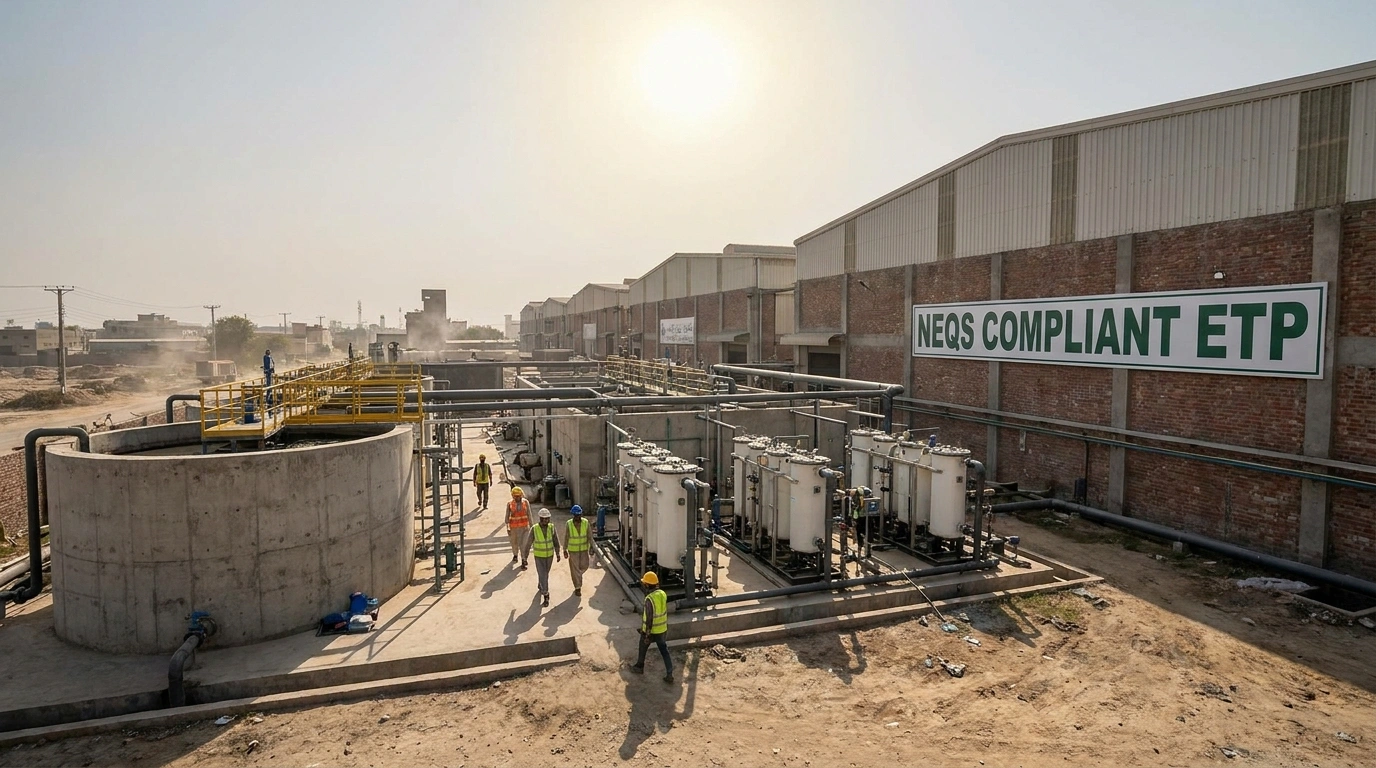
A complete textile effluent treatment plant using MBBR typically follows a six-stage sequence: screening and equalisation, coagulation-flocculation, primary clarification, MBBR biological treatment, secondary clarification, and polishing with filtration or ozone. Each stage targets a specific category of contaminants, and skipping any stage is usually what causes compliance failure.
Stage-by-Stage Treatment Sequence
- Screen and equalise: Bar screens remove fibre and coarse solids. An equalisation tank buffers pH and flow rate variations before downstream treatment.
- Coagulate and flocculate: Alum or ferric chloride, sometimes enhanced with electrocoagulation, removes colour-causing colloidal dye particles and reduces suspended solids.
- Primary clarification: A primary settler removes the precipitated sludge before the effluent enters biological treatment.
- MBBR biological treatment: The core stage. Organic load, BOD, and residual COD are reduced by the attached biofilm community on the plastic carriers.
- Secondary clarification: Settling removes any detached biofilm and remaining suspended solids before the final polishing stage.
- Polishing: Sand filtration, ozone treatment, or UV disinfection depending on the final discharge or reuse target. For mills targeting NEQS discharge into a municipal drain, ozone handles residual colour and disinfection in a single step.
WCSP has designed and commissioned complete systems following this sequence for mills in Faisalabad producing denim fabric, in Lahore manufacturing knitted garments, and in Karachi operating synthetic fibre processing. The footprint for a 500 cubic metre per day system typically fits within 600 to 800 square metres, which is achievable within most existing factory layouts. Learn more about WCSP’s complete wastewater treatment system design and installation.
Can MBBR Be Retrofitted Into an Existing Treatment Plant?
Yes. MBBR is one of the most retrofit-friendly upgrades available to Pakistani textile mills running ageing activated sludge systems. Existing aeration tanks can be converted to MBBR by adding plastic carriers and upgrading the aeration diffuser arrangement. This avoids the cost of building new concrete civil structures and can usually be completed during a planned maintenance shutdown.
The conversion process involves installing stainless steel or HDPE carrier retention screens at the tank outlet, replacing coarse-bubble diffusers with fine-bubble membrane diffusers calibrated to keep the carriers in motion, loading the tank with carriers to 50 to 60 percent fill ratio, and seeding the system with either sludge from a working plant or commercial bioaugmentation cultures.
WCSP completed an MBBR retrofit at a Sialkot surgical textile plant in 2022, converting two existing 400-cubic-metre aeration basins. The retrofit increased effective biological treatment capacity by 70 percent without adding concrete work, and the plant achieved NEQS compliance within 45 days of commissioning. The entire conversion was executed over a 12-day shutdown window.
For mills where biological treatment alone is insufficient because of high colour load or heavy metal contamination, WCSP integrates the MBBR with a Fenton oxidation stage upstream or an MBR polishing stage downstream. WCSP’s membrane bioreactor service (link: /membrane-bioreactor/) provides the additional suspended solids and pathogen removal that discharge-to-irrigation reuse scenarios require.
What Does Textile Wastewater Treatment Cost in Pakistan, and What Is the ROI?
Capital costs for a textile wastewater treatment plant using MBBR in Pakistan range from Rs 15 million to Rs 80 million depending on daily flow volume, effluent complexity, and the degree of automation required. Operating costs typically run between Rs 8 and Rs 18 per cubic metre of treated effluent. Water recovery and reuse significantly reduces the payback period by offsetting fresh water purchase costs.
For a textile mill in Faisalabad processing 1,000 cubic metres of effluent daily, the operating cost at Rs 12 per cubic metre works out to approximately Rs 360,000 per month. Against this, consider that fines for NEQS non-compliance under PEPA can reach Rs 100,000 per day, fresh groundwater extraction costs are rising as aquifer levels in central Punjab decline, and water reuse after treatment can offset 40 to 70 percent of a mill’s fresh water intake.
The economic picture also includes export market access. European buyers increasingly require GOTS or ZDHC compliance documentation from Pakistani suppliers. Mills that cannot demonstrate responsible effluent management are being dropped from supply chains. WCSP has seen clients in Karachi’s export processing zones secure long-term contracts with EU buyers after completing treatment plant upgrades, with the treatment capex recovered within 18 to 24 months purely through contract retention.
For mills considering zero liquid discharge to eliminate discharge liability entirely, WCSP’s ZLD service (link: /zero-liquid-discharge-zld/) combines evaporation, reverse osmosis, and brine concentration in a sequence that recovers 95 percent or more of process water. WCSP’s reverse osmosis plant service (link: /reverse-osmosis-plant/) handles the clean permeate recovery stage within ZLD systems.
How Does WCSP Design a Custom Textile Wastewater Treatment System for Your Plant?
WCSP follows a four-phase project methodology: effluent characterisation and treatability testing, conceptual and detailed engineering design, manufacturing and civil construction, and commissioning with operator training. This sequence ensures the system is designed for your actual effluent, not a generic assumption, and that your team can operate it independently after handover.
The process begins with a 72-hour composite effluent sample programme. WCSP’s environmental monitoring team collects samples across a full production cycle, covering all process stages from desizing through finishing. Laboratory analysis covers COD, BOD, TSS, colour, pH, temperature, heavy metals, and priority dye classes. This data informs the treatability study, which tests coagulant doses, biological performance, and polishing requirements at bench scale before the full system is designed.
Design deliverables include process flow diagrams, mass balances, P&ID drawings, equipment specifications, civil layout drawings, electrical and control system design, and an operations and maintenance manual. WCSP uses PLC-based automation with SCADA visualisation on all plants above 200 cubic metres per day capacity, enabling remote monitoring and alarm management. Real-time monitoring integration (link: /water-quality-monitoring/) allows plant managers to track effluent parameters against NEQS limits on a dashboard, with automatic alerts if any parameter trends toward a violation threshold.
FAQ — Schema Ready
Q1: What is the best technology for textile wastewater treatment in Pakistan?
For most Pakistani textile mills, a combined system using coagulation-flocculation, MBBR biological treatment, and optional polishing with ozone or sand filtration provides the best balance of performance and cost. This configuration achieves NEQS-compliant COD and BOD levels and addresses colour removal in a footprint that fits within most existing factory layouts.
Q2: How effective is MBBR for textile effluent treatment?
MBBR achieves 85 to 95 percent BOD removal and 75 to 90 percent COD reduction on typical textile effluent. For mills with high colour loads, MBBR is most effective when combined with upstream electrocoagulation. Standalone MBBR without a coagulation pre-treatment stage will reduce organic load but will not achieve adequate dye removal for NEQS compliance in most textile applications.
Q3: What are the NEQS effluent standards textile mills in Pakistan must meet?
Pakistan’s NEQS for industrial liquid effluent requires textile mills to discharge at COD below 200 mg/L, BOD below 80 mg/L, total suspended solids below 150 mg/L, pH between 6 and 10, and temperature below 40 degrees Celsius. Provincial EPAs enforce these standards with fines beginning at Rs 100,000 per day for non-compliance and can escalate to plant closure orders for repeat violations.
Q4: How much does a textile wastewater treatment plant cost in Pakistan?
Capital cost for an MBBR-based textile wastewater treatment plant in Pakistan typically ranges from Rs 15 million for a small 200 cubic metre per day system to Rs 80 million or more for a large 2,000 cubic metre per day fully automated plant. Operating costs generally fall between Rs 8 and Rs 18 per cubic metre. Actual costs depend on effluent complexity, reuse targets, and automation level required.
Q5: Can an existing activated sludge plant be upgraded to MBBR?
Yes, MBBR retrofit is one of the most cost-effective upgrade options available. Existing aeration tanks are converted by adding plastic biofilm carriers, installing carrier retention screens, and upgrading the diffuser system. Civil construction is minimal. WCSP has completed MBBR retrofits at textile sites in Sialkot and Faisalabad within 10 to 14 day shutdown windows, increasing biological treatment capacity by 50 to 80 percent.
Q6: How long does it take for an MBBR system to achieve full treatment performance?
An MBBR system seeded with activated sludge from an existing plant typically reaches stable treatment performance within 14 to 21 days. Systems seeded with commercial bioaugmentation cultures without existing sludge may require 30 to 45 days. Operating temperature and organic load affect startup time. WCSP provides commissioning support and performance guarantee periods on all installed systems.