
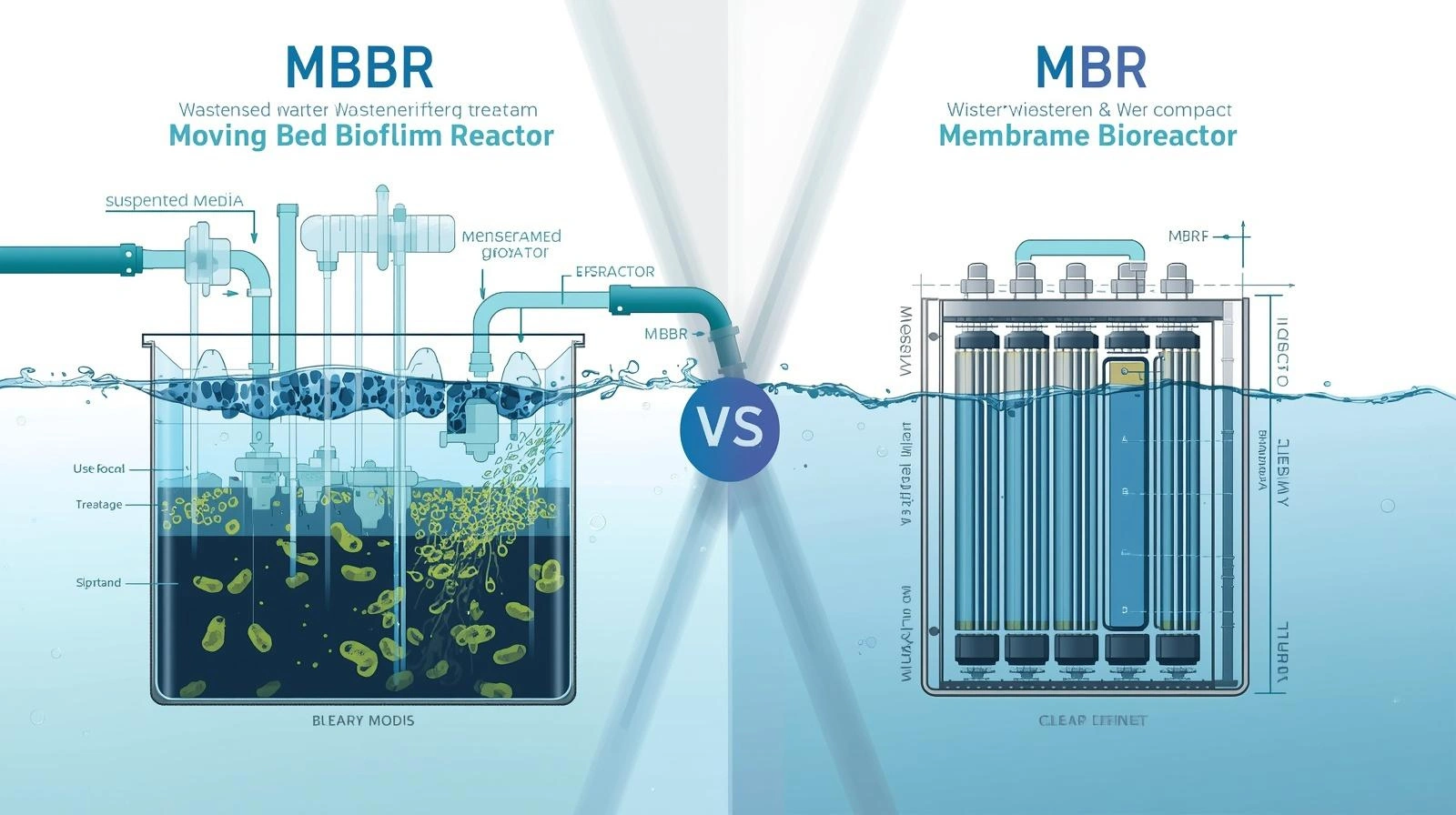
In this guide, we’ll explore the key differences between MBBR and MBR, providing you with actionable insights to help you make an informed decision. Whether you are in the early stages of designing an industrial effluent treatment plant (ETP) or seeking to upgrade your existing system, this comparison will equip you with the knowledge you need to choose the best technology for your specific requirements.
What Are MBBR and MBR?
MBBR (Moving Bed Biofilm Reactor) is a biological wastewater treatment process that uses biofilm growth on plastic carriers suspended in a reactor. The biofilm attaches to these carriers, allowing bacteria to break down organic pollutants in the wastewater. MBBR is known for its compact design, lower energy consumption, and ability to treat high organic loads.
MBR (Membrane Bioreactor) combines conventional biological treatment methods with membrane filtration. In an MBR system, activated sludge processes are used to treat wastewater, while membranes (usually ultrafiltration or microfiltration) separate treated water from the mixed liquor. This allows MBR to produce very high-quality effluent, suitable for reuse or discharge into sensitive environments.
MBBR vs MBR: Key Differences
1. Treatment Efficiency
- MBBR: MBBR is effective for treating both high and low organic loads, but its effluent quality is generally lower compared to MBR. It does not offer the same level of solid-liquid separation, which can affect water clarity and the final quality of treated water.
- MBR: MBR systems excel in producing high-quality effluent with significantly reduced suspended solids and very low turbidity. The membrane filtration ensures that even the smallest particles are removed, making it ideal for applications where effluent quality is a top priority.
Pro Tip: If you’re dealing with wastewater that needs to meet stringent discharge standards or be reused, MBR may be the better choice due to its superior effluent quality.
2. Cost Considerations
- MBBR: MBBR is generally more affordable both in terms of initial investment and operational costs. It requires less energy and fewer components compared to MBR, making it a cost-effective solution for treating large volumes of wastewater.
- MBR: While MBR systems provide superior effluent quality, they come with a higher capital cost and operational costs due to the membrane filtration system. Membrane fouling and the need for regular maintenance can add to the overall expense.
Expert Insight: For industries or municipalities operating on a limited budget, MBBR can be a more economical option, especially if high-quality effluent is not critical.
3. Maintenance and Operational Complexity
- MBBR: MBBR is known for its relatively low maintenance requirements. The biofilm carriers are self-cleaning, and the system does not require complex equipment or frequent monitoring. This makes it a good option for operators with limited technical expertise or resources.
- MBR: MBR systems are more complex to operate and maintain. The membranes need regular cleaning and replacement, and fouling can occur, especially in high-loading situations. These systems require more advanced monitoring and maintenance, which can increase operational downtime.
Pro Tip: If your team is new to wastewater treatment or lacks specialized maintenance staff, MBBR could provide a simpler and more manageable solution.
Performance Comparison
| Feature | MBBR | MBR |
| Effluent Quality | Moderate (good for general treatment) | High (excellent for sensitive discharge or reuse) |
| Capital Cost | Lower | Higher |
| Operational Cost | Lower | Higher |
| System Complexity | Simple | Complex |
| Maintenance Requirements | Low | High |
| Membrane Requirement | None | Membranes needed |
- for many industrial applications.
- Can I upgrade from MBBR to MBR?
Yes, many facilities start with MBBR and later upgrade to MBR as discharge standards become stricter or as the need for higher effluent quality arises. - Which system is better for municipal wastewater treatment?
MBBR is often sufficient for municipal applications where cost and space efficiency are important, but MBR may be necessary for more stringent discharge standards.
4. Space and Flexibility
- MBBR: One of the major advantages of MBBR is its compact design. The system is ideal for locations where space is limited or where the available footprint is not large enough for conventional treatment systems.
- MBR: MBR systems are generally larger and more complex, requiring a more significant footprint due to the need for membrane filtration tanks, aeration tanks, and other associated components.
Expert Insight: If space is at a premium or if you’re working with a small-scale operation, MBBR’s space-efficient design can be a significant advantage.
5. Suitability for Different Applications
- MBBR: MBBR is versatile and can handle a variety of wastewater types, including municipal, industrial, and agricultural effluent. It is particularly effective in systems where the focus is on reducing organic load and COD (Chemical Oxygen Demand) rather than achieving ultra-pure effluent.
- MBR: MBR, with its high-quality effluent, is suitable for applications requiring strict water quality standards, such as in food processing industries, pharmaceutical manufacturing, and water recycling for non-potable use. It’s ideal for situations where water reuse is a key concern.
Pro Tip: If your wastewater needs to meet strict discharge standards or undergo further treatment, such as reuse for irrigation or industrial processes, MBR is the better choice.
6. Case Studies: Real-World Applications
- Case Study 1: Municipal Wastewater Treatment in Norway
In a large-scale municipal wastewater treatment plant in Norway, an MBBR system was chosen for its low energy consumption and ability to handle high organic load. The system provided adequate effluent quality for discharge into local water bodies at a fraction of the cost of MBR. - Case Study 2: Food and Beverage Industry in the USA
A food processing plant in the USA switched to an MBR system to comply with local discharge regulations. The system’s ability to produce high-quality effluent with minimal suspended solids enabled the plant to recycle water back into the process, cutting water costs by 25%. - Case Study 3: Textile Manufacturing in India
A textile factory in India opted for MBBR to treat its industrial effluent. While the system was less costly to implement, it was eventually upgraded to an MBR system when stricter environmental regulations required higher water quality for discharge.
Conclusion
Choosing the right biological treatment technology—MBBR or MBR—depends on your specific needs, budget, and operational constraints. While MBBR offers a cost-effective solution with a low maintenance profile and adequate effluent quality, MBR stands out in applications where effluent quality is paramount. If you are looking to recycle water or discharge into sensitive environments, MBR might be the optimal choice.
For businesses seeking efficiency and affordability, MBBR provides the best balance between cost and performance. However, if your goal is to push the boundaries of water treatment and meet the highest standards for reuse or discharge, investing in an MBR system could deliver substantial long-term benefits.
FAQs
1. What is the primary difference between MBBR and MBR?
MBBR relies on biofilm carriers for treatment, while MBR uses membrane filtration for superior effluent quality. MBR provides better treatment but comes with higher operational costs.
2. Which system is more cost-effective?
MBBR is typically more affordable both in terms of capital and operational costs compared to MBR.
3. Can MBR systems be used for water recycling?
Yes, MBR systems produce high-quality effluent, making them ideal for applications that require water reuse, such as irrigation or industrial processes.
4. Which system requires more maintenance?
MBR systems require more maintenance due to the need for regular membrane cleaning and replacement.
5. Is MBBR suitable for high organic loads?
Yes, MBBR can effectively treat wastewater with high organic content, making it suitable When it comes to wastewater treatment, businesses and municipalities are continually faced with the challenge of choosing the most efficient and cost-effective solution. Two of the most common biological treatment technologies are Moving Bed Biofilm Reactors (MBBR) and Membrane Bioreactors (MBR). But with so many factors to consider, from space and cost constraints to treatment efficiency and maintenance requirements, how do you know which system is right for your needs?