
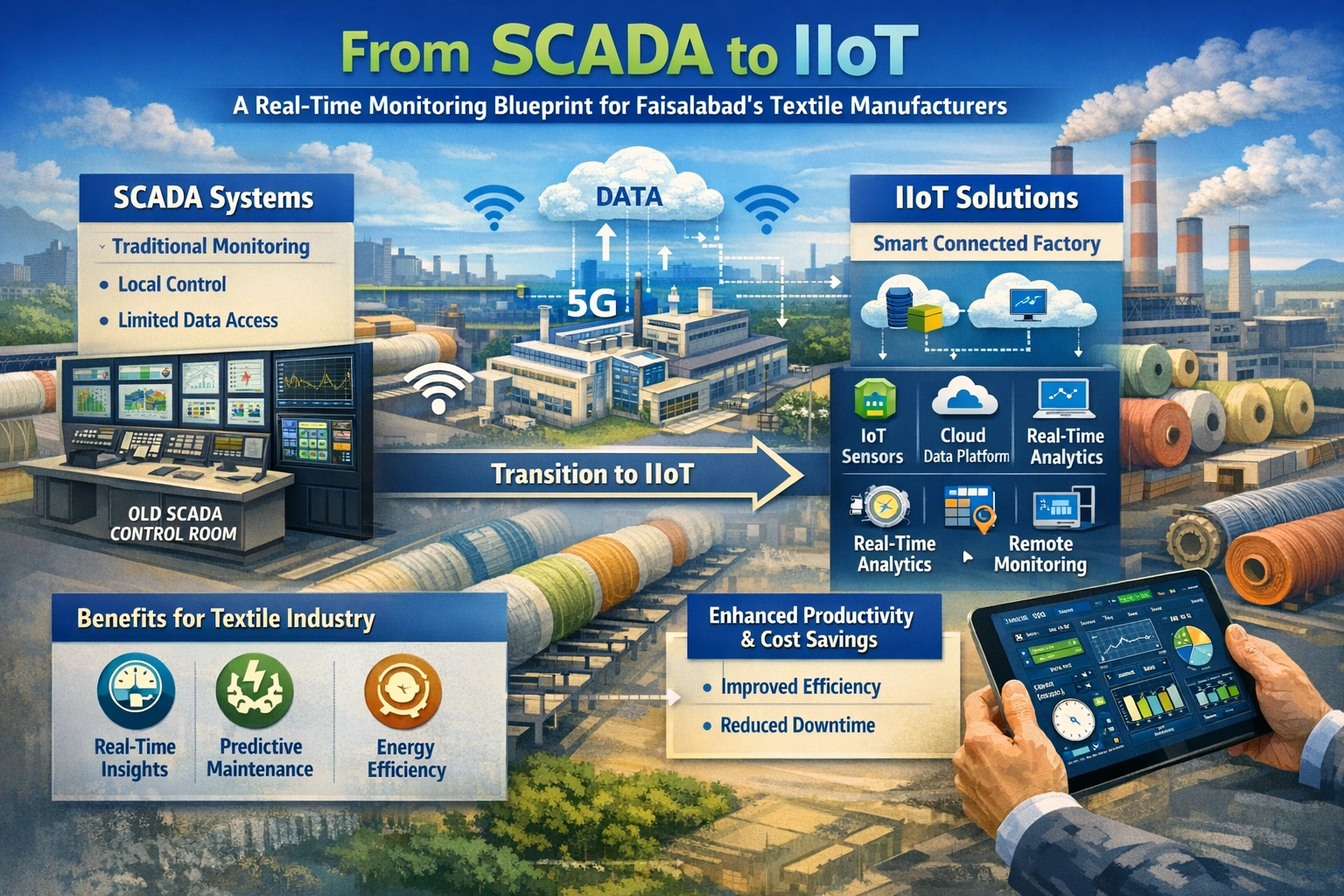
Are you ready to modernize your textile manufacturing operations? As the textile industry continues to evolve, the integration of Internet of Things (IoT) technologies has revolutionized how companies monitor, manage, and optimize their operations. Faisalabad, one of Pakistan’s textile hubs, faces immense pressure to improve operational efficiency and reduce environmental impact, especially when it comes to wastewater management.
Textile manufacturers in Faisalabad are already familiar with the SCADA (Supervisory Control and Data Acquisition) system. However, to meet modern industry standards, it is critical to upgrade to IIoT (Industrial Internet of Things). This shift will help manufacturers transition from passive to real-time, data-driven decision-making processes. By integrating IIoT in textile wastewater treatment, companies can improve not only their environmental compliance but also boost overall operational efficiency.
In this post, we will explore how the shift from SCADA to IIoT can drive better real-time monitoring for Faisalabad’s textile manufacturers, particularly in the context of textile ETP (Effluent Treatment Plants).
Why SCADA Systems Fall Short in Modern Textile Manufacturing
What makes SCADA systems outdated in the textile industry today?
SCADA has long been the backbone of process control in industries like textiles, providing remote monitoring and control of equipment. However, while SCADA is effective for managing data from machinery, its capabilities are limited in the age of smart manufacturing. Here’s why:
- Lack of Real-Time Data Analysis: SCADA systems collect data, but they don’t always provide actionable insights in real time, making it harder to make quick decisions.
- Limited Integration: SCADA systems often operate in silos, making it difficult to integrate with newer technologies or external data sources.
- Energy and Resource Inefficiency: In wastewater treatment, for example, SCADA systems don’t offer the granular control needed to optimize energy consumption and resource usage effectively.
In contrast, IIoT offers continuous real-time monitoring, enabling better decision-making, predictive maintenance, and enhanced efficiency. For Faisalabad’s textile sector, upgrading to IIoT can dramatically transform operational strategies, especially for wastewater management in textile ETP systems.
What is IIoT and Why Should Textile Manufacturers Embrace It?
What exactly is IIoT, and how does it benefit textile manufacturers?
IIoT refers to the integration of sensors, devices, and software applications with cloud-based platforms, allowing manufacturers to track, control, and optimize operations from anywhere, anytime. For textile manufacturers, IIoT brings the following advantages:
- Real-Time Monitoring: IIoT enables continuous monitoring of water quality, machinery performance, and energy consumption in textile wastewater systems, leading to smarter decisions and reduced costs.
- Predictive Maintenance: With IIoT, textile factories can predict equipment failures before they occur, reducing downtime and saving on repair costs.
- Improved Data Accessibility: Unlike SCADA, IIoT systems can consolidate data from multiple sources and provide actionable insights to operators and managers, driving more effective resource allocation.
By upgrading to IIoT, Faisalabad’s textile manufacturers can gain deeper insights into textile ETPs and wastewater management, ensuring compliance with environmental regulations and boosting sustainability efforts.
The Role of Real-Time Monitoring in Textile Wastewater Treatment
How does real-time monitoring benefit textile wastewater treatment?
Wastewater treatment is one of the most challenging aspects of textile manufacturing. Textile effluents contain chemicals, dyes, and other contaminants, making proper treatment critical for both environmental compliance and sustainability.
With IIoT-enabled real-time monitoring, textile manufacturers can track key metrics like:
- pH Levels: Ensuring the water remains within permissible pH limits for discharge.
- Chemical Oxygen Demand (COD): Monitoring the effectiveness of the effluent treatment process.
- Flow Rates: Controlling the flow of water to prevent overuse of energy and chemicals.
Through continuous feedback from IIoT sensors, manufacturers can adjust the treatment process instantly, ensuring efficient use of resources and compliance with environmental standards.
Key Benefits of SCADA to IIoT Upgrade for Textile ETPs
What are the key benefits for textile manufacturers who switch to IIoT?
Upgrading from SCADA to IIoT provides multiple advantages, particularly when it comes to textile ETP systems. Here are the top benefits:
- Enhanced Efficiency: By switching to IIoT, manufacturers can automate processes, eliminate human error, and optimize energy use.
- Reduced Operational Costs: IIoT offers the potential to lower the costs of chemical usage, energy consumption, and waste management.
- Better Compliance: With continuous real-time monitoring, manufacturers can more easily comply with environmental regulations, avoiding fines and potential shutdowns.
- Sustainability: IIoT enhances the overall sustainability of textile factories by minimizing water waste and enabling better reuse practices.
How to Implement IIoT for Textile Manufacturers in Faisalabad
What steps should textile manufacturers in Faisalabad take to implement IIoT?
Implementing IIoT in a textile manufacturing environment may seem daunting, but breaking it down into manageable steps can simplify the process. Here’s a step-by-step guide:
- Identify Key Areas for IIoT Integration: Focus on the textile ETP system, water consumption, and energy efficiency.
- Install IoT Sensors: Place sensors on wastewater treatment equipment, pumps, and filtration systems.
- Integrate with Cloud Platforms: Choose a cloud-based system that consolidates data from different sources for real-time analysis.
- Train Staff: Ensure operators and managers are trained to use the new IIoT systems effectively.
- Regular Data Analysis: Set up automated alerts to trigger maintenance when data indicates potential problems.
By taking these steps, Faisalabad’s textile manufacturers can transition smoothly from SCADA to IIoT and start benefiting from real-time monitoring.
Case Studies: IIoT in Textile Wastewater Management
What are some examples of IIoT success in the textile industry?
Several textile companies worldwide have embraced IIoT, showcasing its effectiveness in wastewater management. Let’s look at a few case studies:
- Case Study 1: Indian Textile Factory: An Indian textile factory upgraded to IIoT for its ETP, reducing chemical usage by 20% and cutting energy consumption by 15%. The factory was able to monitor real-time data on water quality, improving effluent discharge compliance.
- Case Study 2: European Textile Manufacturer: A European textile manufacturer implemented IIoT to monitor water usage and wastewater quality. The real-time data helped them identify inefficiencies, saving thousands of dollars annually and improving their sustainability credentials.
These examples demonstrate how IIoT can transform wastewater management, helping manufacturers reduce waste, improve sustainability, and comply with regulations.
Conclusion
Why should Faisalabad’s textile manufacturers upgrade to IIoT?
The upgrade from SCADA to IIoT offers textile manufacturers in Faisalabad the opportunity to improve their operations significantly, particularly in wastewater management. IIoT enables real-time monitoring, providing actionable insights into textile ETPs and ensuring compliance with environmental regulations. The benefits are clear: better resource allocation, reduced costs, and improved sustainability.
By embracing IIoT, textile manufacturers can streamline their operations, boost their sustainability efforts, and achieve long-term cost savings. The future of textile manufacturing is connected, efficient, and real-time.
FAQ
1. What is IIoT in textile wastewater treatment?
IIoT in textile wastewater treatment refers to the use of sensors and connected devices to monitor, control, and optimize wastewater treatment processes in real time.
2. How does IIoT improve textile wastewater management?
IIoT improves textile wastewater management by providing continuous monitoring, enabling quick adjustments, and ensuring compliance with environmental standards, thus improving efficiency.
3. Can IIoT help reduce operational costs in textile manufacturing?
Yes, IIoT enables better energy usage, reduced chemical consumption, and more efficient waste management, leading to lower operational costs.
4. What are the key components of an IIoT system for textile manufacturers?
Key components include sensors for real-time data collection, cloud-based platforms for data integration, and automated control systems for process optimization.
5. How long does it take to implement IIoT in a textile ETP?
The timeline depends on the scale of the operations, but typically, it takes 6-12 months for full implementation, including sensor installation and staff training.
6. Is IIoT compatible with existing SCADA systems?
Yes, IIoT can be integrated with existing SCADA systems to enhance functionality and enable real-time monitoring without requiring a full system overhaul.